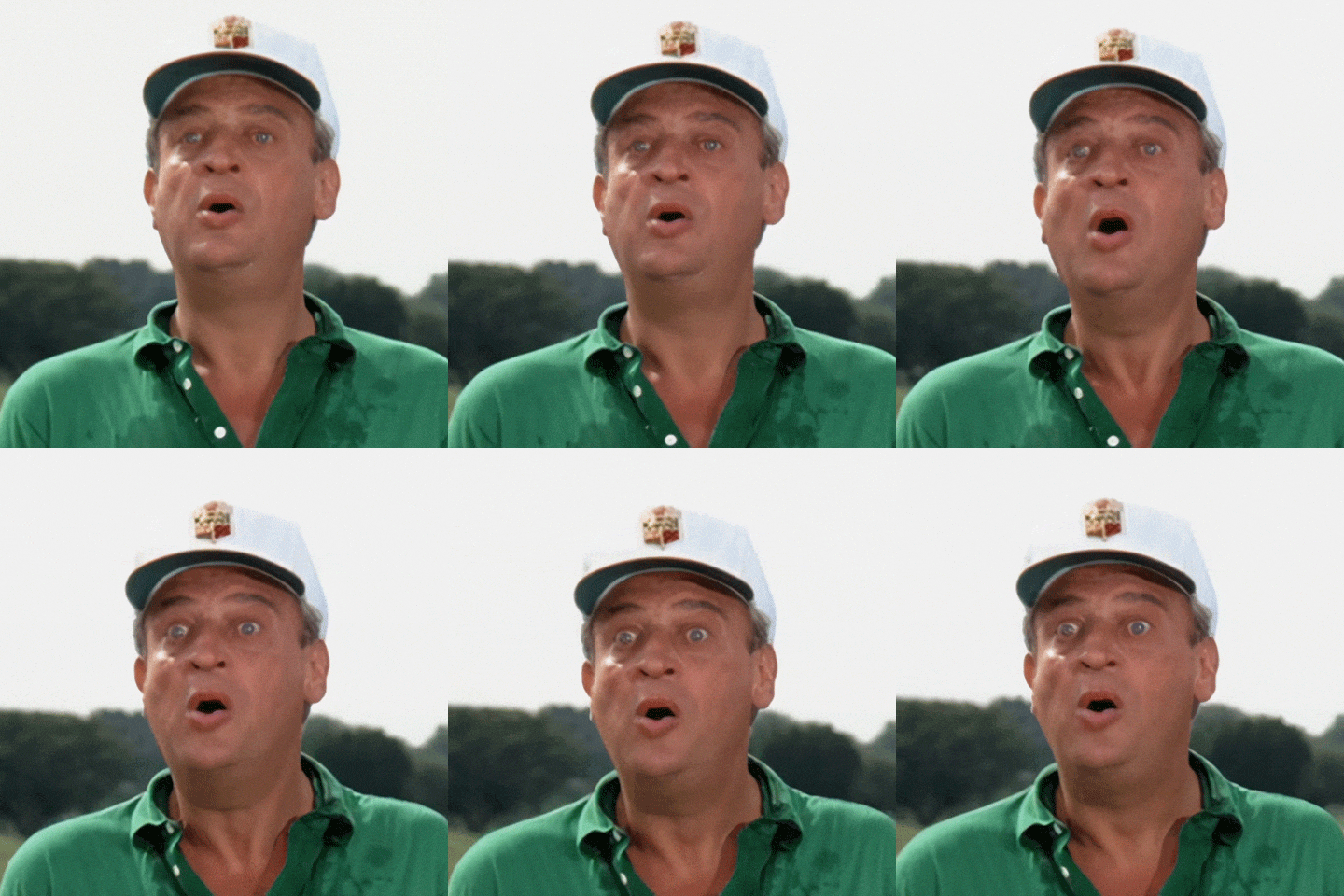
Frequently Annoying your Customers
Running your ad too often doesn't build loyalty — it builds resentment. A breakdown of the 4-stage ad funnel and why increasing frequency is the wrong fix for a conversion problem.


Selling copies of your book can feel like a bad trade-off, but getting to know your crowd is easier than ever.
The best marketers on the platform only care about one thing. Share of voice.
Forcing bottom-of-funnel tactics onto top-of-funnel traffic is a common reason campaigns fail to convert.
The psychology of this is an old concept.
In 1898, an advertising pioneer named Elias St. Elmo Lewis developed the AIDA model (Attention, Interest, Desire, Action) to map the psychological journey of a buyer.
In 1924, William H. Townsend visualized this framework as a funnel, demonstrating how a broad audience narrows down into a concentrated group of buyers.
Today, we will help you organize your thoughts into a framework, while using the Amazon advertising console.
If your campaigns are unprofitable, you can usually isolate the failure in this four-stage sequence:
1. Awareness (Measured in Impressions)
“Why does it matter at all to know this?”
Most authors assume low impressions mean they just need to raise their bids. But forcing higher bids on stagnant targets is often just buying frequency against the same uninterested shoppers.
You are paying to nag the same people over and over without generating results.
Testing: You can temporarily buy your way up the index, but your budget will quickly get liquidated the second you stop spending on targets that actually help you grow.
So why run top-of-funnel awareness targets at all?
Because it is an indexing strategy.
You may have an idea of what keywords you need to rank for, but you might not have the organic authority to do it yet.
Awareness targets buy you temporary access to that broader audience when their immediate interest is much lower.
You are intentionally accepting lower conversion rates to acquire the data needed to scale the other stages of your funnel.
This is why awareness is the widest part of your ad architecture. It provides cost efficiency and cheaper clicks, capturing shoppers with a lower immediate purchasing propensity, specifically to feed data into your higher-converting targets.
2. Consideration (Measured in Clicks)
Claude Hopkins argued in Scientific Advertising (1923) that an advertisement should be judged by the same standard as a salesperson.
Once you buy the data through awareness, you have to compete on the Search Engine Results Page (SERP).
If your campaigns generate high impressions but struggle to get clicks, it usually indicates your target audience is seeing your book but choosing your competitors. The market is rejecting your offer on the page.
This requires an evaluation of your placement. Are you losing on review parity compared to adjacent ads?
Is your price point misaligned for that specific keyword intent? The click is one of the clearest indicators that your cover and title are viable against the competition in that specific sub-genre.
3. Conversion (Measured in Sales)
“Half the money I spend on advertising is wasted; the trouble is I don’t know which half.” — John Wanamaker (circa 1889)
Amazon advertising can get expensive very quickly. This is why many authors waste half their budget, just like Wanamaker, on ideas meant to put out the fire.
When conversion fails here, it doesn’t automatically mean your detail page is broken. Frequently, it means you bought the wrong intent.
You targeted a broad or misaligned keyword, the shopper clicked out of curiosity, and they bounced when your detail page revealed a different trope or sub-genre than they expected.
You must qualify the traffic, and in doing so you will open up more opportunities to grow.
4. Loyalty (Read-Through): Your Defensive Perimeter
“The purpose of a business is to create and keep a customer.” — Theodore Levitt (1983)
For series authors, long-term profitability relies heavily on read-through.
Do not rely on your back pages to do the work for you. Remind them in two weeks, or even six months, that they are missing out on much more.
Building a defensive perimeter helps secure the series continuation. This is why cross-targeting by adding your own ASINs into ad-groups is one of the first steps people usually learn, but what if you could take advantage of that reflex?
By deploying defensive ASIN targeting and Sponsored Display retargeting campaigns on your own catalog, you actively direct the reader where they need to go next.
This structure helps ensure the cost of acquiring that initial reader pays out over the lifetime of the series.
Thank you!
Frequency is only a problem relative to what a conversion is worth. The break-even calculator works that out from your royalty, your borrow share, and your series read-through.