Your Backlist Needs a Search Plan
Why good books go quiet on Amazon, and how to find the exact spot where readers get lost before they buy.

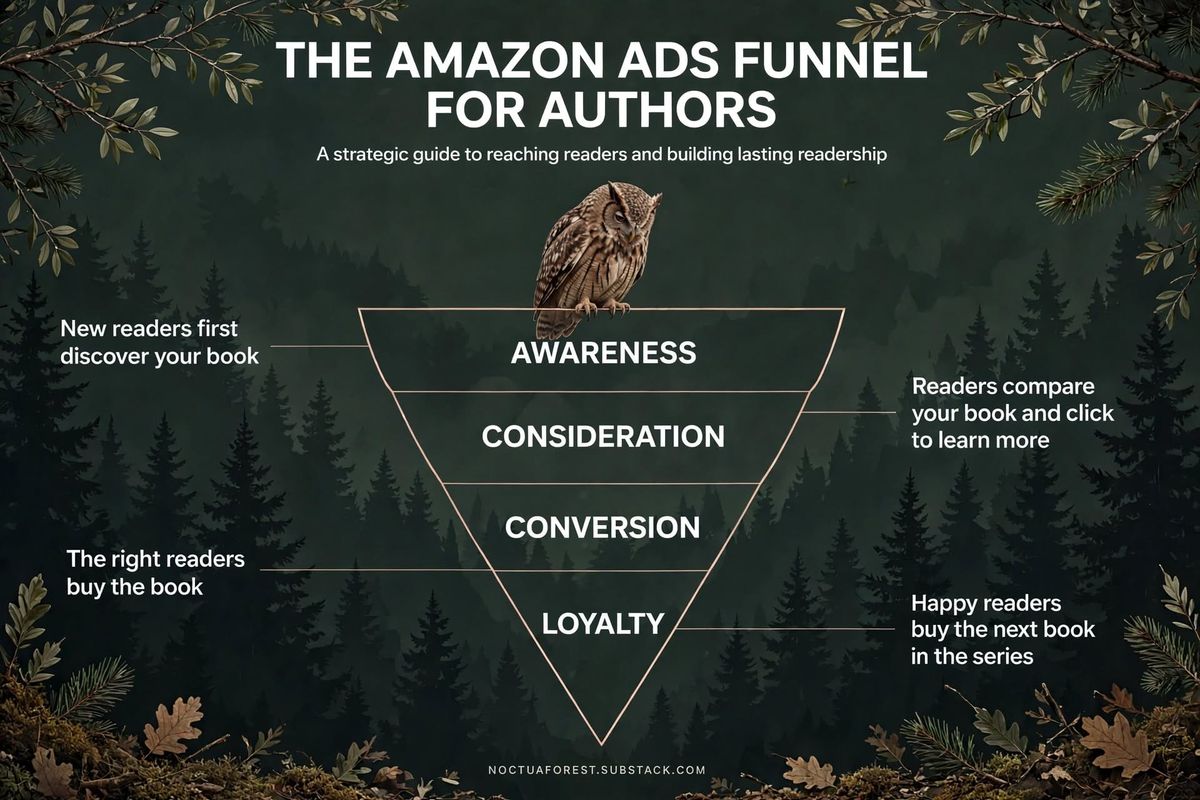
Why good books go quiet on Amazon and how to find where readers get lost.
How can you make it easier for readers to find the right book in your catalog? Work out how a reader actually gets from a search to each of your titles, then fix the first spot where they get lost. That's a search plan. The bigger your backlist gets, the more you need one.
Picture a reader typing a trope into the Amazon search bar and clicking the first thing that looks close enough. Your book never shows up, even though it was the better fit. It's frustrating. The cover's good, and your Sponsored Ads might even be converting on the keywords you already know about.
Every book you add to a catalog is another trail in the forest, and after enough of them it gets hard to see the trails from where you're standing. You know every book because you wrote them, but a new reader shows up knowing only the mood they're in or the trope they're hunting for and they need an obvious way to the title that fits.
"Enthusiasm is common. Endurance is rare." - Angela Duckworth, Grit (2016)
As an Amazon advertising consultant who works with authors I have seen it first hand where a title that drives awareness for their backlist gets shoved to the side during the holidays for titles that really only work for a loyal audience. Sales dip. Clients aren't happy. There isn't an easy solution to fight the algorithm. You just have to be ready for the drop-off.
Chasing visibility for every book on every search term gets expensive fast. I'd rather an author knew two things first: where readers come into the catalog, and where they wander off before buying.
How readers find books on Amazon
Older books can keep selling for years as long as readers can still reach them. When a backlist title slows down, the instinct is to blame the book. New cover, new campaign. Sometimes that's the right call, but plenty of times the book is fine and it's just lost in the forest.
Amazon's search results are built from signals like your title, subtitle, series name, keywords and categories. A reader searching for a trope sees whatever the algorithm decides is the closest match. If those signals are vague or don't match from one book to the next, your book can stay invisible to the exact reader it was written for.
Readers usually know what they want before they know what publishing calls it. A parent shopping for a preschooler might type "bedtime books about dinosaurs." A romance reader types "grumpy sunshine small town" and expects Amazon to know exactly what she means. Either of them can reach your book from a search result, a Sponsored Ads placement on someone else's product page, your author page or a series page.
If your book doesn't connect clearly to wherever they came in, the person most likely to buy it may never see it. Then a good book ends up looking weak in your data. So before you write off a quiet title, ask where the right reader would expect to run into it. If you can't answer that quickly, start there.
How to grow reader loyalty to your backlist
Loyalty on Amazon mostly shows up as read-through: readers finishing one of your books and going straight to the next. Before you touch individual titles, lay the whole catalog out, standalones and every format included. Then mark which books work as a first read and which ones only make sense once a reader already likes you.
You'll probably spot overlap while you're at it. Two of your books might be fighting over the same search term with nothing on either page telling a reader which one to pick. Or a later book is perfect for fans of an earlier one and there's no visible link between them on Amazon. That gap costs real money once you're paying for clicks, since a reader who keeps going after book one is worth far more than the first sale. If you write in series, my series break-even calculator shows how read-through changes what you can afford to bid.
💡 Don't skip the series field!
A+ content won't link your books together. Amazon doesn't search the words inside those images.
One author I've known for several years paid an agency thousands for A+ content, but her books still weren't connected as a series: no series page, no "Book 2 of 5," and no clear next book for readers. The fix was free: fill in the series name and number in KDP, keep the name identical on every title, and use all seven keyword boxes.
You don't need a perfect spreadsheet for any of this. A rough list with your KDP Bookshelf open beside it is plenty to start with.
The core concept of Amazon ads you are missing
The concept I'd put at the center of any Amazon ads plan is the path to purchase. That's the route a reader takes from wanting a certain kind of book to buying one of yours. Every title needs its own. Book one has to sell the premise and make it obvious where to start, while book four mostly lives off the series page and the readers book one already sent its way. Standalones are harder. They have to earn every reader on their own, and if it's a niche title you'll usually need tighter search terms than you would for a broad one.
Sponsored Ads double as research here. Your search term report shows the exact words readers typed before they clicked. The placement report tells you whether those clicks came from Top-of-Search, Rest of Search or Product Pages, which says a lot about where the book gets noticed. Just keep in mind that an ad only gets a reader to the page. If the product page doesn't answer what they came for, you paid for the click and got nothing. The author below had a version of that across a whole series.
A kids literature author I recently started working with came to me with a $5,000 budget and highly optimized listings. He told me he just needed help optimizing and managing ad spend. I reviewed his titles. They had continuity but left one thing out: the answer to why buying the full series was important for the parents. The first book had many sales and high quality reviews but it was as if his readers didn't even know the other titles existed.
For each title that matters, jot down where you think readers come in. Any book where you honestly can't say is the one to dig into first.
Optimizing your ASINs for sales
Once you've mapped the paths, walk one yourself the way a stranger would. Open a private browser window so your own history doesn't skew the results (the same trick I use to check whether a book is indexing), then:
- Search a phrase a new reader would actually type, like a trope or the problem the book solves, and note where your book lands.
- Click through to the product page and ask whether a stranger could tell who the book is for and where it sits in the series.
- Look for the next step, like the series link under the title or your other books in the also-boughts.
- Pull your search term report and flag any terms sending clicks to a book that only half fits.
Wherever you hesitate, assume readers do too. Usually the fix is one page, and the pages to be suspicious of are the ones that assume a reader already knows the series as well as you do.
One author I know who came to me for consultation asked why his campaigns were getting so many add-to-carts but no sales. The answer was not as simple as it may seem. He had spent weeks making small changes and waiting for results. What he failed to see in his sales funnel was the complete journey. If the reason a reader clicks on your book cover is completely different from why they should add to cart, then maybe you are attracting the wrong crowd.
So for every break you find, ask what a reader would need to see on that page to make the next click obvious. Often it's tiny. The reading order, or one line in the description about why book two is worth buying.
Choosing what to change
You'll end up with more fixes than you can handle at once. That's normal. Start with the books that act as a way in, like a first-in-series or your strongest standalone, along with anything that's already getting clicks but isn't converting.
I'd also resist the urge to redo the whole backlist in one weekend. Change ten things at once and you'll have no idea which one worked, so pick a couple and give them a few weeks before you judge them. What you watch depends on what you changed. Maybe that's read-through to book two after a series fix, or conversion rate after you've pointed an ad at a better page.
Catalog work is a lot less exciting than a launch, which is probably why it gets ignored, but it keeps earning on books you've already written. So if you only do one thing this week, walk one path like you've never seen your catalog before and fix the first spot where you'd stop and wonder what to click. Your backlist already has the right book for a lot of readers. Help them find it.